
Intimacy by the Numbers
What We Lose When Intimacy Requires Proof

My Personal Reflections
This week, the audio diary is available for paid subscribers. It shares my personal experiences, reflections, and thought process around the themes explored in the essay. Listening offers a deeper perspective. However, the essay itself still stands on its own.
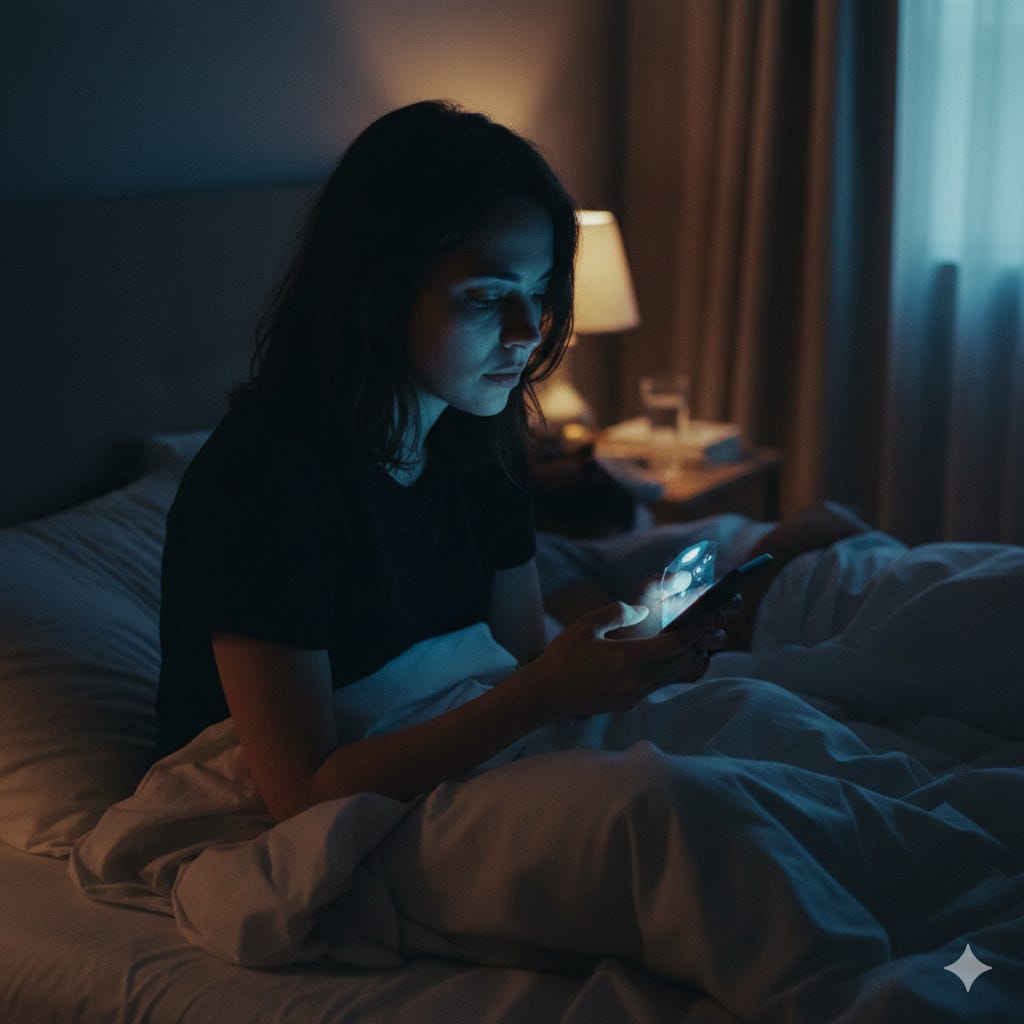
A woman scrolls through her partner’s Instagram activity at 2am, not from suspicion, but curiosity. She tracks the timestamp gaps between his likes, whose posts he lingered on, his ‘Last Active’ status more precisely than his breathing beside her. When she sets down her phone, the thought arrives: she has been treating him like a database to query rather than a person to know.
Is this pathology? Or is she simply literate in the only language contemporary intimacy speaks?
For decades, the psychologist Sherry Turkle has argued that technology has thinned our connections, that performance now precedes feeling, that we reach for the phone in order to generate emotion rather than express it. In her account, the edited, asynchronous self gradually displaces the messy, present one. Presence becomes optional; vulnerability, inefficient. The diagnosis resonates because we recognize the scene. Couples sustain long-distance relationships through morning voice notes and shared Spotify queues. There is often an unspoken rule: never go to sleep without sending something: a heart emoji, a song, some proof of thought. When read receipts show ‘Read 3h ago’ with no reply, the delay becomes interpretable as relational data. It is not necessarily evidence of declining affection, but it signals something subtler: a shift in attentional hierarchy. Where do I sit in the queue of their consciousness?
When one partner forgets to send a goodnight message, falling asleep at an inopportune time, the other may experience it as a kind of system failure. The ritual has broken. Without the ritual, what evidence remains? It is tempting to interpret this as dependency on mediated presence, an inability to trust connection that leaves no trace. The prescription seems straightforward: put down the phone, reclaim unmediated conversation, return to presence.
That frame, however, assumes there was once a pure, unmediated baseline to which we might return. History offers little support for that idea. Intimacy has always been shaped by infrastructure. Romantic love required architectural innovations such as private bedrooms, locks on doors and hallways that permitted discretion.
The love letter was as mediated as the text message, only slower. The telephone was denounced in the early 20th century for eroding face-to-face conversation. Every era calibrates its forms of care to the technologies available to it. What distinguishes the present is not mediation itself, but its speed and its visibility.
Digital intimacy is not a simulation of connection; it is a new form of relational labor. Sociologist Nancy Baym describes the daily stream of micro-gestures, forwarded memes, collaborative playlists, ambient awareness of someone’s mood or location, as maintenance work. This work is subtle and continuous. It reassures, coordinates and signals attention. The architecture looks different from handwritten letters or scheduled calls, but the emotional stakes are familiar. Consider location-sharing between partners. Often it is not deployed from jealousy, but experienced as closeness itself. Knowing where someone is feels like connection. The moving map pin becomes a placeholder for presence because ambient awareness has become a genuine way of knowing.
The difficulty is not that these gestures are insincere. It is that they are legible. In earlier eras, much of intimacy unfolded in opacity. A 45-minute phone call in which one friend simply held space for another’s grief produced no durable trace. Its meaning resided in memory and mutual trust. Today, emotional life increasingly leaves data exhaust. Platforms quantify response times, track patterns of engagement and translate affection into streaks, hearts and correlations. Sociologist Eva Illouz has described this broader transformation as ‘emotional capitalism’, in which feelings do not merely occur privately but circulate, accumulate and generate value. A shared Spotify queue can be both a tender collaboration and a data point about taste alignment. A read receipt can reassure and simultaneously function as a metric.
This does not mean the care is counterfeit. It means that care is now documentable, and documentation reshapes what counts. When intimacy becomes measurable, it becomes comparable. Thirty minutes on the phone last night; three hours since he replied; six likes on someone else’s photo; none on mine. The metrics generate narratives, and the narratives generate feeling. The infrastructure makes interpretation continuous.
Anthropologist Robin Dunbar’s research suggests that humans can sustain deep emotional intimacy with only a handful of people, and meaningful connection with perhaps a few dozen. Digital platforms, by contrast, promise indefinite expansion. In practice, we do not maintain profound intimacy with hundreds of people. What we maintain is the performance of intimacy at scale: the low-level signaling, the ambient checking, the circulation of acknowledgment. Performance has always accompanied care. Victorian calling cards and obligatory correspondence required their own choreography. The contemporary difference is that the performance is constant. Gaps themselves acquire meaning, and silence invites interpretation.
What many of us seem to mourn is not depth but invisibility: the ability to love without producing evidence, to trust connection without tracking it. Yet invisibility was never complete. Lovers saved letters. Families preserved photographs. Diaries catalogued feeling. Evidence has always mattered. The change lies in the fact that documentation is no longer deliberate; it is ambient. It accumulates automatically, whether we intend it to or not. Once the archive exists, it invites analysis.
The woman at 2am understands this intuitively. Her scrolling is not only suspicion; it is a search for epistemic reassurance. She wants to know where she stands, whether she occupies space in another person’s attention. Each timestamp appears to answer a question: when did he turn toward the world, and when away from me? The phone offers granular proof that earlier forms of intimacy could not provide. Proof soothes anxiety, but it also sharpens it. The more precise the data, the more charged each deviation becomes.
Some couples resist by cultivating opacity. They disable read receipts, delete certain apps or embrace slower forms of communication. They fall asleep on FaceTime with the video off, sharing breathing across distance. They send voice notes because pauses cannot be edited. These practices create friction within the system, but they do not exist outside it. The broader infrastructure remains in place, quietly converting attention into data and data into value. The business model rewards uncertainty: the small doubt that prompts another check, another scroll, another query. Each act of reassurance feeds the archive.
The vertigo of contemporary intimacy does not arise because connection has become fake. It arises because connection has become visible to systems that can store, sort and monetize it. Care generates data; data generates value. Under such conditions, we begin to treat one another as queryable surface, searchable histories, sortable behaviors, analyzable gaps. Love becomes not only an experience but also a dataset.
However, datasets do not eliminate uncertainty; they reorganize it. The more we know about patterns, the more significant departures from those patterns feel.
When the woman sets down her phone, she experiences both relief and loss. Relief from the constant interpretive labor; loss of the clarity the metrics provided. Without the timestamps, she must tolerate ambiguity. Without the read receipt, she must rely on memory, tone and the steady rhythm of breath in the dark. Trust, in this sense, is not the absence of technology but the willingness to live without continuous evidence.
Tomorrow she may check again. The archive will still be waiting, and the infrastructure will continue to hum. But for the moment, she allows the space between herself and her partner to remain unmeasured. The darkness offers no dashboard and no notification, only presence that cannot be replayed or verified. In choosing not to convert that presence into data, she does not escape the system that surrounds her. She simply accepts that evidence and assurance are not the same thing, and that intimacy sometimes requires inhabiting the difference.